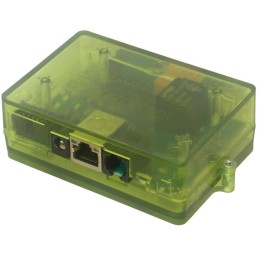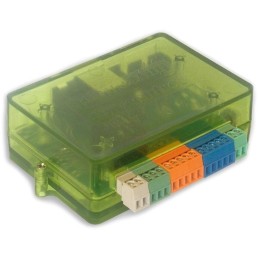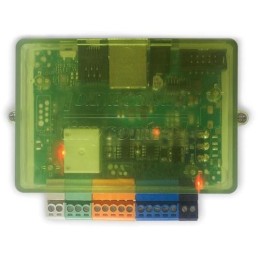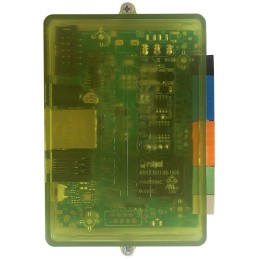
Tinycontrol LAN driver v4.0
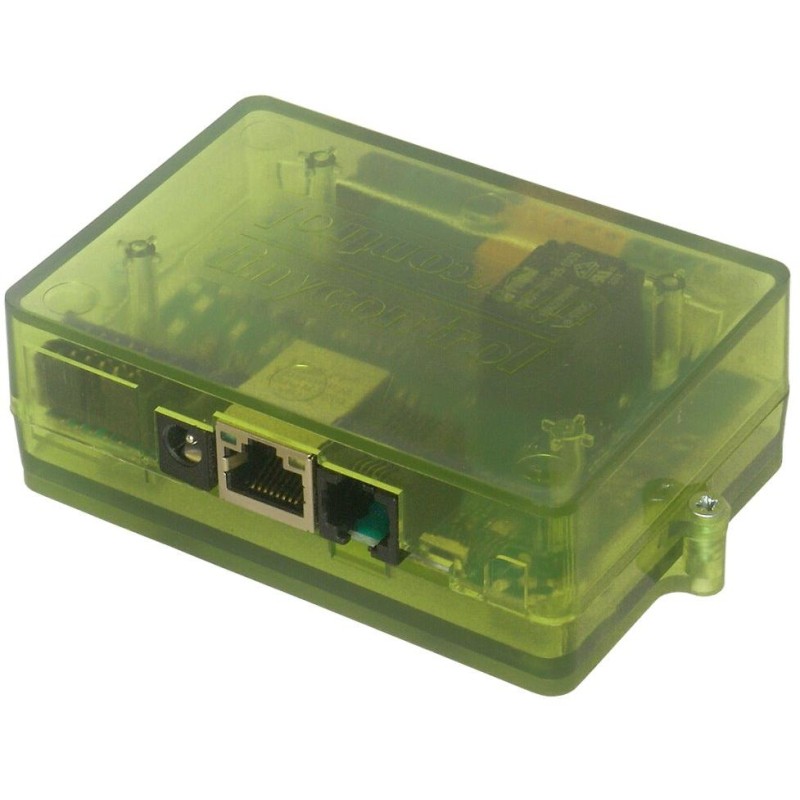
LAN controller with relay is a simple, versatile and affordable device for controlling outputs based on information from various sensors. It serves as a web server that displays various types of sensors and allows remote control of outputs.
In addition, it is possible to program events and corresponding actions to meet conditions on any of the sensors. A scheduler that allows the device to be turned on/off at a certain time or for a certain period of time can be suitable for many applications. There are 3 PWM outputs for controlling lighting or an electric motor.
The new LAN controller v4.0 integrates all the previous IoT experiences into one universal device. It represents a smooth continuation of the previous series, now in a more practical form.
Dual communication interfaces:
You can use a wired Ethernet connection, a wireless Wi-Fi connection (802.11n), or both at the same time. There is also a variant with LTE connectivity. The LAN controller can be fully configured from a web page available on the built-in web server. It is also possible to send arbitrary commands to the device via HTTP (bypassing the web page) or MQTT (after configuring the connection).
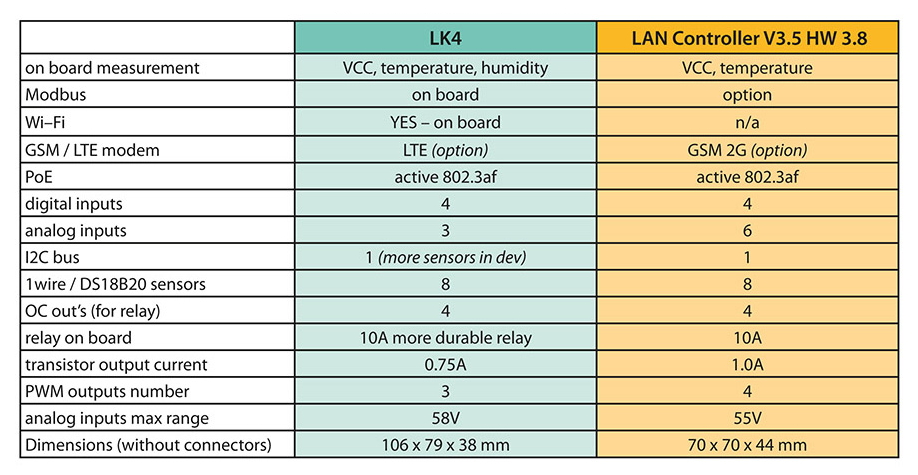
Comparison of versions 3.8 (3.9) and 4.0:
Usage examples:
- Automatic heating control when the temperature drops or rises outside the set limit
- Turning lights or other devices on/off
- Monitoring/control of a solar power plant – battery voltage, voltage and current from PV panels, power and production from the inverter, switching of appliances depending on the intensity of sunlight on the panels, etc.
- Irrigation control/flood detection
- Security based on PIR sensor or door/window opening detection
- Remote monitoring of Sofarsolar solar controllers connected via Modbus LAN controller
Hardware:
- 3 analog inputs with switchable range - (2× 0–3.3 V or 58 V, 1× 0–5 V or 58 V), for measuring DC voltage, AC voltage (additional sensors), operating pressure sensors, thermocouples, distance sensors, photoresistors for measuring lighting and many others
- 4 logic inputs – as a status sensor for monitoring opening, infrared motion sensors, for a manual switching button with the option of bistable mode, as a pulse counter from an electricity meter, as a time counter between consecutive input resets
- 1Wire and I2C input – up to 8× DS18B20 temperature sensor, I2C for connecting various devices, e.g. temperature and humidity sensors, air quality (PM) sensors, CO2 measurement sensors, OLED displays with configurable text display and others (see list of supported sensors below)
- UART interface for communication with external devices via serial port
- RS-485 bus to support devices with Modbus RTU protocol
- 1 relay (NC, NO, C), 10 A/250 V
- 1 transistor output, provides supply voltage at the output, to control devices with current consumption up to 0.6 A
- 4 transistor (OC) outputs for switching relays
- 3 inPWM outputs 1 Hz to 1 MHz
- Measurement of temperature, humidity and supply voltage on the board
Software:
- Modern and responsive web interface
- Possibility to configure the status bar yourself, upload your own background, select and place the necessary data and buttons
- Two levels of access (login) – as administrator for configuration and as user for status display
- Scheduler for setting 50 programmed time events
- Extended event table with the ability to enter 3 conditions, including time events from the scheduler
- Possibility to configure reading from your own Modbus RTU devices – up to 5 non-standard devices
- Watchdog for monitoring and resetting devices with IP address
- Modern communication protocols: SNMP, HTTP and MQTT
- Support for encrypted TLS connections for HTTP, SMTP, MQTT or SNMP v3 protocols
- HTTP client that allows you to configure and control other devices – for example, controlling a Wi-Fi relay (Smart Relay) or displaying sensor data in the camera image (supports Basic Authentication and Digest Access Authentication methods)
- Possibility of collecting data from all connected devices and sensors, remote switching of outputs and remote configuration via the MQTT protocol on the mqtt.ats.pl service and in the mobile application
- Many features available through the above service, such as setting up reactions and tasks (performing actions under certain conditions and at a certain time) spanning multiple devices
- Sending notifications by email, via MQTT protocol or SMS (LTE variant only) as a result of an event
- Possibility of sending data from sensors via Modbus TCP protocol
- Remote control from one to multiple devices via UDP – useful as a button implementation over the internet
- Time synchronization with the Internet (NTP)
- Maintaining the state of outputs and energy counters until power is restored
- Convenient software update and backup functions from the device's website
- Wireless control of devices with Tasmota firmware
- Mobile application
BASIC SPECIFICATIONS
Supply voltage: 8-58V
Power consumption: 0.5 W
PoE: yes, 802.3af, mode A passive with jumper
Interface: Ethernet 10/100Mbps, Wi-Fi (802.11n)
Relay: 10A, 250VAC
Operating temperature: –20 to +85 °C
Dimensions: 106 × 79 × 38 mm
Weight: 130g
The LAN controller is supplied with a DIN rail installation box without a power supply.
Power supply is possible in two ways - with a classic jack power supply or a PoE injector .
For usage examples and more information, see Technical Support .
The manufacturer provides an MQTT cloud service for status display and control via the Internet. Thanks to this service , outputs can be switched or controlled without routing settings.o monitor the status of the LAN controller in the local network, but the operation of the service cannot be guaranteed. In case of using the MQTT service, you can also use the mobile application . It is available for Android devices and allows you to control the outputs and monitor the status and values of the inputs simply via your phone .
.png)
Overview of currently supported sensors and devices
Analog inputs
- Alternating voltage: AC-meter
- Alternating current: SCT-013-000, SCT-013-030
- Direct current: ACS711EX_15, ACS711EX_30, ACS709_75, ACS711LC_12.5, ACS711LC_25, ACS711LC20, WCS1800, WCS6800, LA100P
- Temperature sensor: PT1000 (with additional resistor)
Logic inputs (digital)
- Magnetic door opening sensor, etc.
- Infrared motion sensor
- Manual switching button with bistable mode option
- Pulse counter from an electricity or water meter
- Counter of the time between consecutive resets of inputs for measurements, e.g. operation lengths in industrial processes
1Wire bus
- temperature sensor DS18B20
I2C bus
- Humidity, temperature, atmospheric pressure: BME280
- Humidity, temperature: AM2301B, AHT20, AHT25, AM2320, HTS221
- Particulate matter: SPS30, APM10, PM1, PM2.5, PM4, PM10
- CO2: SCD40, ACD10
- 0.96" OLED display
Serial port
- SPS30 and SDS011 particulate sensor
- CO2: MH-Z16, MH-Z19
- Duraluxe photovoltaic inverters
- Ultrasonic distance sensor
- 2D barcode scanner
Modbus RTU
- Eastron two-way electricity meters: SDM120M, SDM72D-M, SDM630M, CHINT DTSU666 (measurement of power, energy, voltage, current and other parameters depending on the meter)
- Epever Tracer solar chargers
- Sofarsolar photovoltaic inverters
- Additional devices and sensors through custom configuration
Modbus TCP
- The Modbus controller can read sensors connected to the LAN controller (tested with Siemens LOGO)
HTTP client
- Wi-Fi smart plugs with Tasmota firmware
- Displaying sensor data in the camera image
- Relay control using Smart Relay