


Reference: NETXTE5898
Brand: XTENDLAN
Reference: NPKUBT0001
Brand: UBIQUITI
Reference: TOCL0390
Brand: COLORWAY
Reference: IH-EGS-2003
Brand: iHealth
Reference: 115760111
Brand: Avast Software s.r.o.
Banner



Business terms and conditions

Delivery policy

Return policy
Your message was successfully sent.
There was a problem with sending your message, please contact us via contact page.
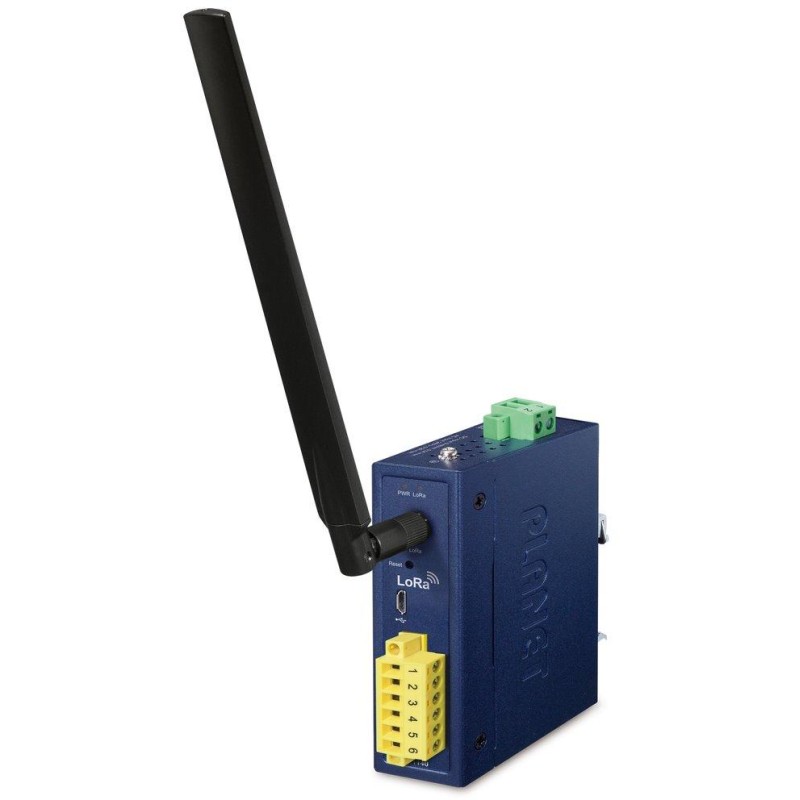
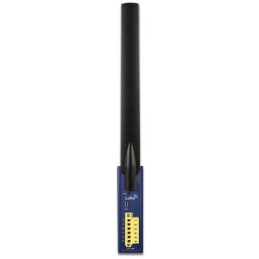
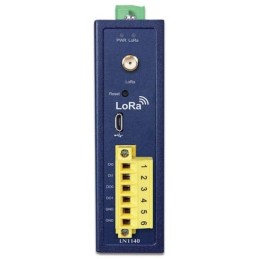
PLANET LN1140
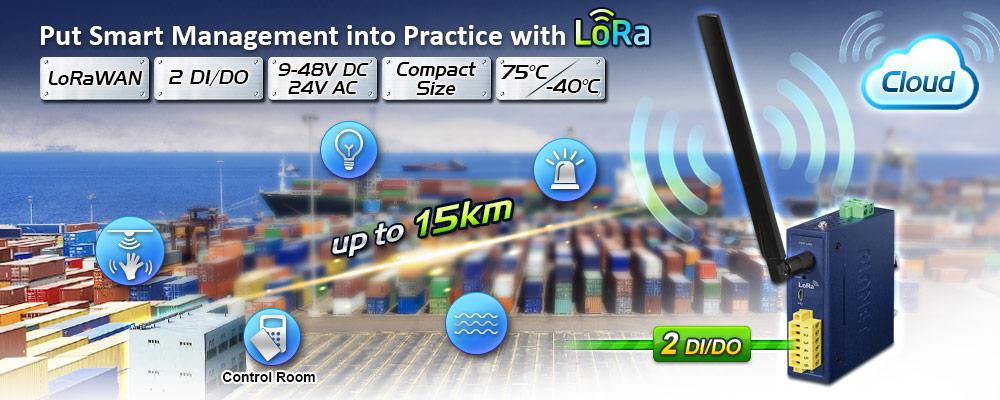
An industrial LoRa node controller that is used to monitor and control devices such as temperature sensors, access control systems, and security systems. It features two digital inputs and two outputs that simplify the deployment and replacement of LoRaWAN networks.
With its industrial design and IP30 metal housing, the LN1140 has wide applications in indoor applications such as smart industry, building automation, etc.
Communication interface:
The LN1140 LoRaWAN controller, with built-in numerous industrial interfaces , connects to all types of sensors, meters and other devices . It also bridges Modbus data between serial and Ethernet networks via LoRaWAN. The LN1140 supports LoRaWAN Class C protocol to be fully compatible with standard LoRaWAN gateways, including PLANET LCG-300 (LCG-300W) series. It is ideal for large-scale deployment of IoT applications, such as building automation projects, smart metering, HVAC system, etc. With multiple interfaces, this LoRaWAN controller can perfectly help to upgrade legacy assets to IoT-enabled form.
BASIC SPECIFICATIONS
Physical properties:
Interface: 1× micro USB (configuration), 6pin terminal block (2× digital input, 2× digital output, 2× ground)
Design: DIN rail, wall-mounted
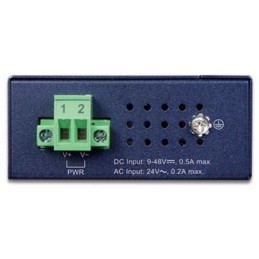
Power supply: DC 9–48 V, or AC 24 V
Operating temperature: -40 to +75 °C, humidity up to 95%
Protection: IP30, metal housing
Dimensions: 104 × 70 × 33 mm
Supported LoRaWAN bands:
LoRa is one of the wireless network protocols used in the world of IoT (Internet of Things).
LoRaWAN (Long Range Wide Area Network) is another low-power wireless network protocol designed for low-cost and secure two-way communication in the Internet of Things. It uses a band up to 1 GHz and the transmission speed is then from 0.3 kb/s to 50 kb/s .
Communication between endpoints The data rate is divided into different frequency bands and transmission rates by the elements and gateways. The choice of data rate is a compromise between the communication range and the message length. The individual communication streams with different transmission rates do not interfere with each other (due to spread spectrum technology) and create a set of “virtual” channels to increase the capacity of the gateway.
To maximize the end device battery life and overall network capacity, the LoRaWAN network server manages the transmission rate and RF output for each end device individually, through an adaptive data rate (ADR) system.
LoRaWAN distinguishes several classes of devices:
class A – end devices support bidirectional communication (each uplink is followed by two data reception windows)
class B – in addition to the "forced" downlink of class A, devices of this class open extraordinary receiving windows at a set time
Class C – reception windows are open almost continuously and close only when transmitting
Data sheet
Your review appreciation cannot be sent
Report comment
Report sent
Your report cannot be sent
Write your review
Review sent
Your review cannot be sent
Our pricing is always guided by the principles of a fair price. We do not artificially move prices or brag about inflated percentages. You can always find price history for each product.
check_circle
check_circle
Are you shopping without registering? You pay more and miss out on important benefits. Registered customers at daycomp.eu receive sales disc ...
 Manual
 Other downloads